What Changes and When to Expect Them
- 공유 링크 만들기
- X
- 이메일
- 기타 앱
Direct answer summary
If you are considering Botox in Nokbeon-dong, you can usually expect softer forehead and frown lines, gentler crow’s feet around the eyes, and in some cases a slimmer jawline if you treat the chewing muscles. The first changes tend to appear within a few days, with the full effect around 1 to 2 weeks, and most people notice visible results for about 3 to 4 months. Deep, long-standing wrinkles rarely disappear completely, but they can look less harsh. Jaw Botox works more slowly, with gradual slimming over several weeks. Results are temporary, differ from person to person, and depend greatly on how carefully the doctor studies your facial muscles and plans the dose.
For residents and office workers around Nokbeon-dong in Eunpyeong-gu, small neighborhood clinics such as Malgeunsu Clinic offer Botox as part of everyday skin and aesthetic care, which can feel more like visiting a familiar local doctor than a large cosmetic center.
What Botox does and common treatment areas
Botox overview
Botox is a neuromodulator, a purified protein that temporarily relaxes specific muscles. It works by blocking the nerve signals that tell a muscle to contract. When those muscles move less strongly, the skin over them creases less, so expression lines soften and certain muscle-driven bulges can reduce.
Botox does not peel, resurface, or fill the skin. It does not lift sagging tissue like a thread lift or remove pigmentation. Its main role is to calm overactive muscles that create wrinkles or bulk.
Wrinkle areas commonly treated
In a typical Nokbeon-dong clinic, the most common Botox areas are:
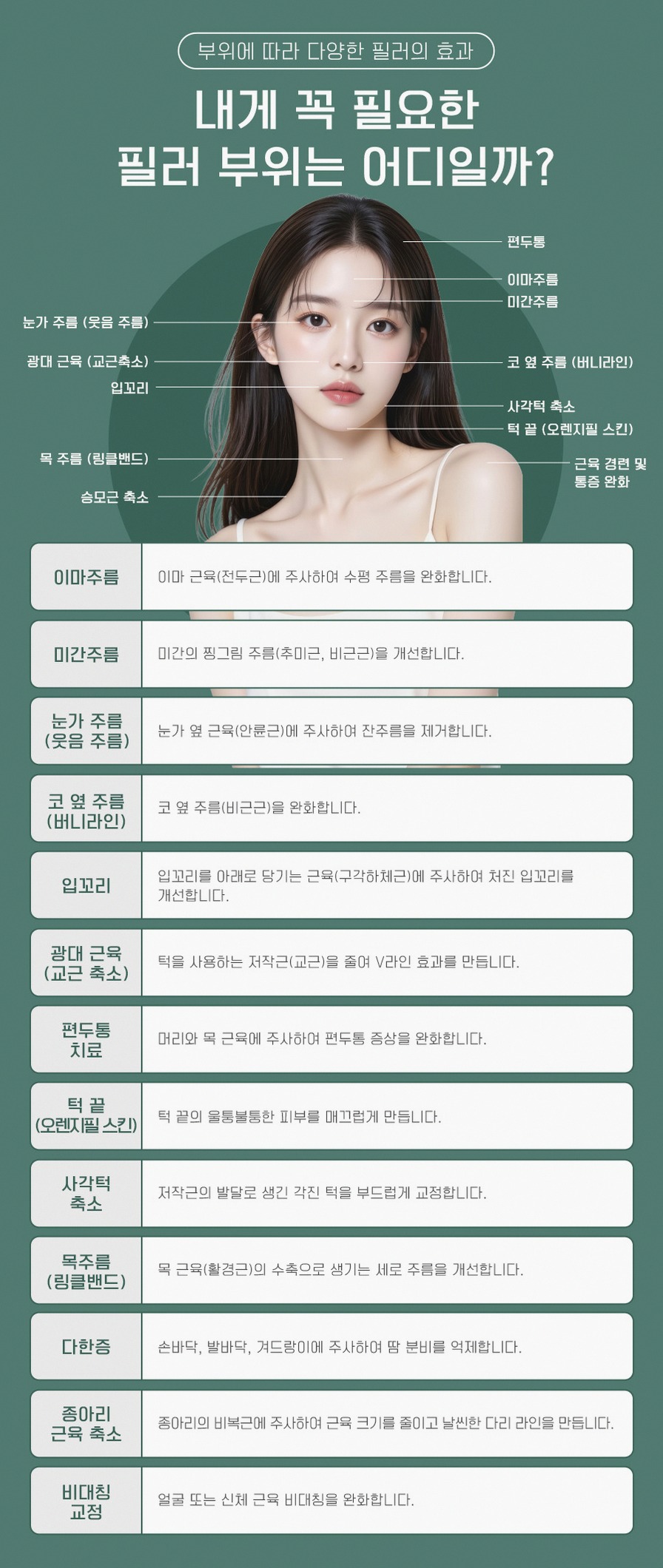
Forehead lines
Horizontal lines that appear when you raise your eyebrows. Botox can help these lines look smoother when you make expressions and can also prevent them from getting deeper. If the lines are already etched in even when your face is at rest, they may soften but not vanish completely.
Frown lines between the brows
Vertical or diagonal lines between the eyebrows that show when you frown or concentrate. Treating these muscles can reduce the angry or tired look and make the area appear more relaxed. This is one of the areas where people often feel a clear change in their expression.
Crow’s feet around the eyes
Fine lines that spread out from the outer corners of the eyes when you smile or laugh. Botox here can make the eye area look smoother and more refreshed, especially in photos. Very fine lines caused by dry skin may still need skincare or other treatments.
Jaw Botox for facial slimming
In East Asia, jaw Botox is a very popular option for people who feel their lower face looks wide or square because of strong chewing muscles. The target is the masseter muscle, located at the angle of the jaw.
By relaxing this muscle, its bulk can gradually decrease over several weeks. In suitable candidates, this can lead to a softer, more tapered jawline when viewed from the front. The effect is usually subtle and natural if the dose is conservative. It does not change the bone shape, and it will not help if the width comes mainly from bone structure or fat rather than muscle.
Jaw Botox can also help some people who clench or grind their teeth at night by reducing the strength of the muscle. However, this is still a medical decision that needs discussion with the doctor, including how it might affect chewing strength.
Other possible facial uses
Some neighborhood clinics may also use Botox for:
Neck bands
Vertical bands on the front of the neck that become more visible when speaking or making expressions. Relaxing these muscles can slightly smooth the neck contour in some people.
Gummy smile
When the upper gums show widely when you smile, small doses of Botox around the upper lip can sometimes reduce how high the lip lifts. The effect is subtle and must be carefully dosed to avoid an unnatural smile.
These are usually secondary options and may not be offered to everyone; they require precise planning and a clear conversation about expectations.
Timeline and duration of Botox effects
When you start to see changes
Botox does not work immediately. Most people notice:
First signs
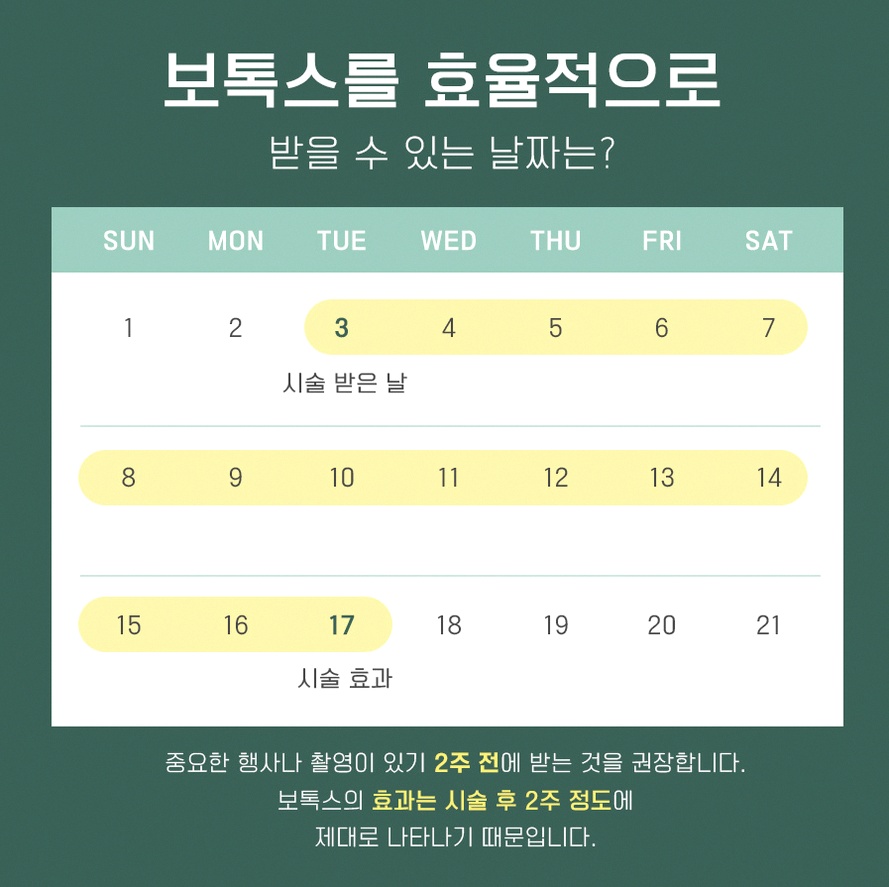
Light changes within 2 to 4 days. Expressions may feel slightly weaker, and lines may not crease as sharply.
Full effect
Around 1 to 2 weeks after injection. At this point, forehead and frown lines usually look as smooth as they are going to get for that treatment cycle. Crow’s feet and smaller lines also show their maximum softening.
Jaw Botox timeline
Jaw Botox is slower. The muscle starts to relax within 1 to 2 weeks, but visible slimming of the lower face often becomes clearer after 4 to 6 weeks, and can continue to refine for up to about 2 to 3 months.
How long the effects last
The duration of Botox varies, but in many Nokbeon-dong patients:
Wrinkle areas
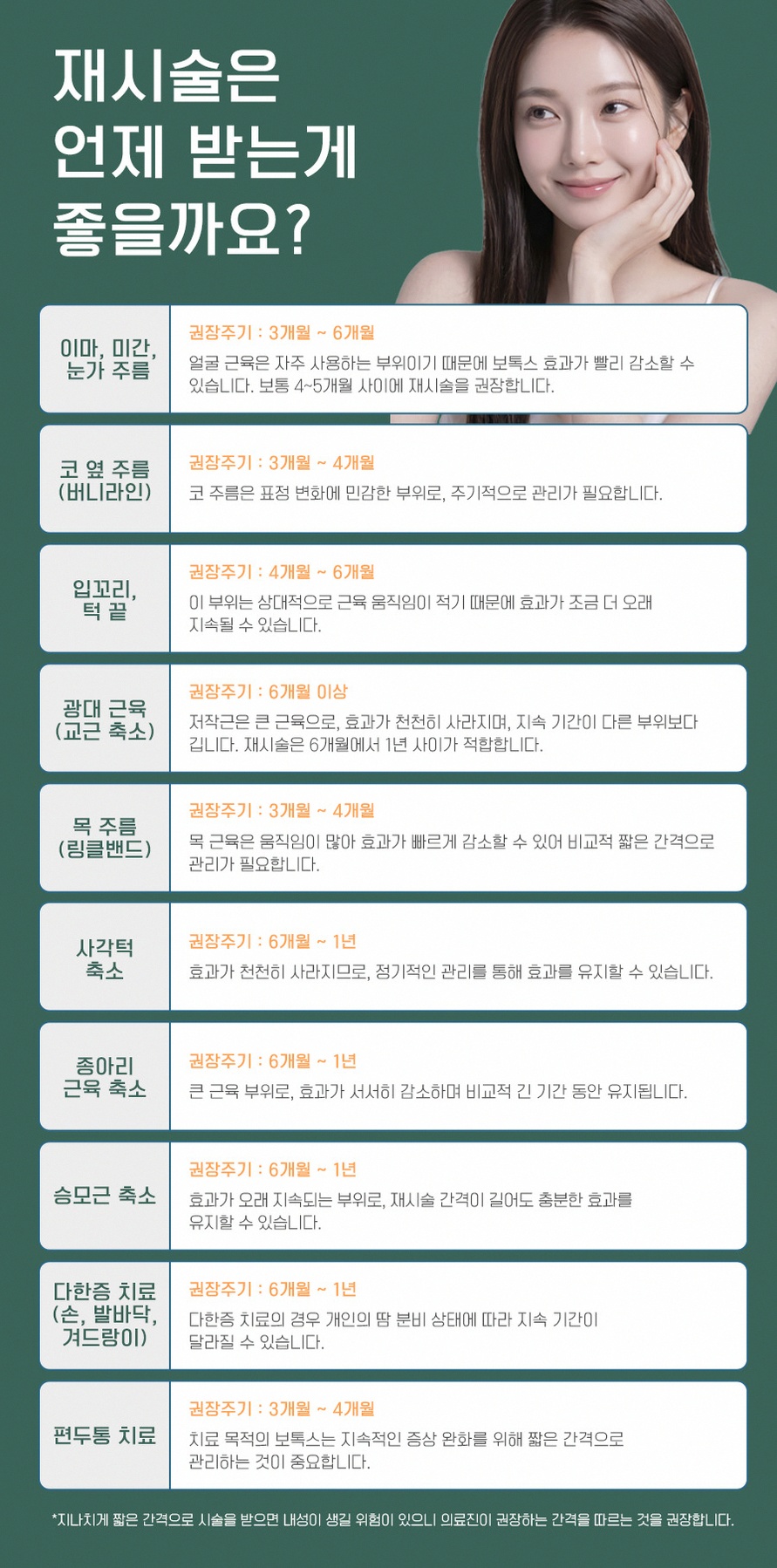
Visible softening often lasts about 3 to 4 months. Some people, especially those with weaker muscles or lower doses, may feel it wears off a bit earlier. Others may keep some effect up to 5 or 6 months.
Jaw Botox
The relaxed, slimmer look can last around 4 to 6 months, sometimes longer, because the muscle has to rebuild its volume.
Factors that influence duration include:
Individual metabolism
People who metabolize medications quickly or who exercise very intensely may feel the effect fades sooner.
Muscle strength
Very strong frown or jaw muscles may need more units and may still recover faster.
Dose and pattern
Conservative dosing preserves more movement but may not last as long as stronger dosing. Your doctor can help balance this.
Because the effect is temporary, many people repeat treatment roughly every 3 to 6 months, depending on age, goals, and budget.
Realistic before-and-after expectations
What you can expect for wrinkles
Forehead and frown lines
In the first cycle, you can usually expect:
Softer lines when you raise your brows or frown.
Less of an angry or stressed look at rest.
A smoother surface in photos and under makeup.
If you already have deep, carved-in lines, Botox alone may not erase them. Instead, they often look shallower and less obvious. Over several cycles, some people see gradual improvement as the skin has time to repair without constant folding, but this is not guaranteed.
Crow’s feet
For the eye area, realistic expectations include:
Smoother outer corners when you smile.
Slightly more open, refreshed-looking eyes.
Fine crinkling reduced, but not always completely gone.
Very fine lines from dryness, sun damage, or thin skin may still be visible and might need skincare, lasers, or other options if they bother you.
What you can expect for the jawline
With jaw Botox, realistic changes are:
A gradual, not sudden, slimming of the lower face over 1 to 2 months.
A softer angle at the jaw in people whose width comes mainly from muscle.
Possible relief of heaviness or tightness in the jaw for some clenchers.
You are unlikely to see:
A dramatic V-line transformation if your jawbone is naturally wide.
A big change after a single very low-dose session.
In many Nokbeon-dong clinics, doctors aim for a natural, balanced look rather than a very sharp, model-like contour, especially for office workers who want subtle changes.
Overall expression changes
When Botox is planned carefully, people around you may notice that you look more rested, less angry, or “fresh,” but they may not be able to tell exactly what changed. If too much product is used or placed in the wrong spots, the face can look stiff or heavy, so it is important to discuss how much movement you want to keep.
Nokbeon-dong context and Malgeunsu Clinic example
Local clinic environment
Nokbeon-dong in Eunpyeong-gu is a residential and office area where many people prefer to visit a clinic close to home or work instead of traveling to major cosmetic districts. This often means they are looking for practical, repeatable care rather than one-time dramatic makeovers.
Malgeunsu Clinic is an example of a small, one-doctor clinic in this area where Botox is offered alongside medical care for skin and scalp conditions. Director Lee Hyo-su personally conducts the consultation and performs the injections, which can help maintain consistency from visit to visit.
Because the clinic also treats issues such as warts, corns, and scalp problems, the doctor is used to looking at skin health, inflammation, and individual differences before deciding on cosmetic procedures. This can be reassuring for people who want both disease management and aesthetic care in one place.
The clinic also has several lifting devices, such as InMode, Shurink Universe, Tense-ra, and Ten Triple. In some cases, these can be combined with Botox in a treatment plan, for example using lifting devices to address mild sagging and Botox to calm expression lines. However, Botox remains a separate procedure with its own indications and timeline.
Safety, side effects, and realistic risk discussion
Common temporary reactions
After Botox injections, many people experience only mild, short-lived reactions, such as:
Redness or small bumps at the injection sites that usually settle within minutes to hours.
Mild swelling or tenderness in the treated area.
Small bruises, especially around the eyes or in people who bruise easily.
These are usually manageable and often do not interfere with daily life.
Less common but important side effects
Less frequent issues can include:
Asymmetry
One eyebrow or corner of the mouth may move differently if muscles on each side respond differently or if the dose is uneven. This can sometimes be adjusted with small additional injections.
Overly frozen expression
If the dose is too strong or spread too widely, the forehead or eye area can look too still. Some people like this; others find it unnatural. Clear communication before treatment helps reduce this risk.

Drooping of eyelids or brows
If Botox diffuses into nearby muscles, it can cause temporary drooping of the upper eyelid or brow. This usually improves over weeks as the effect wears off, but it can be distressing, so careful injection planning is important.
Jaw chewing weakness
After jaw Botox, some people notice that chewing very tough foods feels more tiring. This is usually mild and tends to improve over time.
Because responses vary, it is important to:
Share your medical history, medications, and any previous Botox experiences.
Tell the doctor if you have had drooping or asymmetry in the past.
Discuss your job and lifestyle, especially if you rely heavily on facial expressions.
How a session typically proceeds at a small local clinic
Consultation
At a neighborhood clinic in Nokbeon-dong, a Botox visit usually starts with:
Assessment of your facial expressions
The doctor may ask you to raise your brows, frown, smile, and clench your jaw to see which muscles are strong and where lines form.
Evaluation of wrinkle type and depth
Dynamic lines that appear only with movement respond best to Botox. Static lines that remain at rest may need combined approaches.
Jaw and face shape analysis
For jaw Botox, the doctor will feel the masseter muscle as you clench and look at your face from different angles.
Discussion of main concerns
You might prioritize frown lines over forehead lines, or crow’s feet over jaw slimming. The doctor can help set priorities within your budget and time.
Planning
Once the main areas are chosen, the doctor usually explains:
Injection points and approximate units
Based on muscle strength, face size, and how natural you want the result to look.
Onset and duration
When you can expect to see changes and how long they are likely to last.
Follow-up schedule
Whether the clinic recommends a check-up after about 2 weeks to review the result and discuss future plans.
Procedure
The actual injection process is typically short:
Cleansing
The skin is cleaned to reduce the risk of infection.
Marking
The doctor may mark points on your skin to guide where to inject.
Injections
Fine needles are used, and each injection is usually quick. You may feel brief stinging or pressure, but many people tolerate it without major difficulty.
Total time
For standard facial areas, the injection part often takes only a few minutes, though the full visit is longer due to consultation and preparation.
Aftercare
After Botox, clinics commonly recommend:
Avoid rubbing or massaging the treated areas for several hours.
Avoid very intense exercise, saunas, or hot baths immediately after, according to the clinic’s guidance.
Avoid lying face-down for a few hours.
You are reminded that results are not immediate and that the true effect is evaluated around 1 to 2 weeks later.
Who might consider Botox in Nokbeon-dong
Typical candidates
People in Nokbeon-dong and Eunpyeong-gu who might consider Botox include:
Office workers who notice deepening forehead or frown lines from long hours of concentration.
Adults in their 20s and 30s who want to prevent early fine lines from becoming fixed.
People in their 30s and 40s who already see static wrinkles and want them softened.
Individuals with strong jaw muscles who want a slightly slimmer lower face or relief from clenching-related discomfort.
Residents who prefer a clinic close to home with weekend or evening hours.
People who feel more comfortable with a neighborhood doctor who also manages medical skin issues.
Preventive vs corrective Botox
Preventive Botox
Younger patients with fine lines that appear only with expression may opt for low-dose, preventive Botox. The goal is to reduce repeated folding of the skin so that deep lines form more slowly.
Corrective Botox
For deeper, established wrinkles, Botox is used to soften muscle movement and reduce further worsening. It may be combined with other treatments if the goal is to improve the etched lines themselves.
Small clinic vs large cosmetic center
Large cosmetic centers often have multiple doctors, many staff members, and strong marketing. They may offer a wide range of procedures and packages.
A small clinic in Nokbeon-dong may instead focus on:
Continuity of care
The same doctor follows you over time, remembers your previous doses, and adjusts based on your feedback.
Conservative dosing
Many neighborhood patients prefer natural, office-friendly results rather than dramatic changes.
Practical scheduling
Evening hours and weekend availability can make it easier to fit Botox into a busy workweek.
Online consultation and pre-visit preparation for overseas patients
If you are coming from abroad and considering Botox during a stay in Korea, preparation helps you use your time efficiently.
Before your trip
Collect information
Take clear, natural-light photos of your face from the front and sides, both at rest and while making expressions (raising brows, frowning, smiling, clenching the jaw). These can be helpful for online consultation.
List your concerns
Write down what bothers you most: forehead lines, frown lines, crow’s feet, jaw width, or clenching discomfort. Ranking them helps the doctor prioritize within your schedule.
Medical history
Prepare a list of your medical conditions, allergies, medications, and any previous Botox or filler treatments, including when and where they were done and how long they lasted.
Online consultation
Many small clinics are reachable through local platforms or messaging apps even if they do not have a formal website. You can:
Send your photos and concerns.
Ask whether the clinic usually treats overseas patients.
Confirm which days Botox is available and whether a follow-up visit is recommended.
Expected Korea visit timeline for Botox
For most overseas visitors, a practical timeline might be:
Day 1–2
In-person consultation and Botox treatment. The visit usually fits within a half day, including waiting time.
Day 3–5
Early changes may start to appear, but the effect is still developing. You can usually continue sightseeing and normal activities, avoiding only very intense exercise or saunas immediately after the procedure.
Day 7–14
Full effect is typically visible. If you are staying in Korea for at least 2 weeks, you can schedule a follow-up visit around this time to review the result and ask questions.
If your stay is shorter, it is still possible to have Botox, but you may not be able to return to the same clinic for adjustments. In that case, it is especially important to choose conservative dosing and communicate clearly about your preferences.
Aftercare and living with the results
In the weeks after treatment:
Observe your expressions
Notice whether your forehead, brows, and eyes move in a way that feels comfortable. Some tightness in the first days is normal as you get used to the change.
Sun protection
Use sunscreen and basic skincare to protect your skin. While this does not change the Botox itself, it helps maintain overall skin quality.
Plan your next visit
If you like the effect, you can plan to repeat treatment in about 3 to 6 months. Keeping a note of the date and areas treated will help future consultations.
Frequently asked questions about Nokbeon-dong Botox effects
How long do Botox effects usually last for people in their 20s, 30s, and 40s?
In many patients, Botox effects on forehead, frown lines, and crow’s feet last around 3 to 4 months, regardless of age. People in their 20s with weaker muscles and lower doses may feel that the effect is a bit lighter but can sometimes stretch closer to 4 months. In their 30s and 40s, where muscles are often stronger and lines more established, the visible softening may last a similar length of time but can feel more noticeable because the contrast with the starting point is greater. Jaw Botox often lasts 4 to 6 months in all age groups, as the muscle takes time to rebuild its volume.
What is the difference between preventive and corrective Botox?
Preventive Botox is usually done when lines are still fine and appear mainly with expression. The goal is to reduce repeated folding of the skin so that deep, permanent lines form more slowly. Doses tend to be lower, and the effect is subtle. Corrective Botox is used when wrinkles are already visible at rest or when muscles are very strong. Here, the aim is to soften existing lines and prevent them from worsening. Doses may be higher, and the doctor may also suggest combining Botox with other treatments if the etched lines are a major concern.
How do Botox effects differ between forehead, frown lines, crow’s feet, and jawline?
On the forehead, Botox mainly reduces horizontal lines and can make the upper face look smoother, but too much can make the brows feel heavy, so balance is important. For frown lines between the brows, the effect is often a more relaxed, less angry look, which many people notice clearly. Around the eyes, Botox softens crow’s feet and can make the eye area look more refreshed when smiling. In the jawline, Botox does not affect wrinkles but gradually reduces the bulk of the chewing muscle, which can slim the lower face and sometimes ease clenching-related tension. The onset is faster for upper-face wrinkles and slower for the jaw.
Can Botox be combined with lifting devices or fillers, and when might that be considered?
Yes, Botox is often combined with other treatments, depending on the problem. If the main issue is dynamic wrinkles from movement, Botox is usually the first step. If there is mild sagging or loss of firmness, lifting devices such as InMode, Shurink Universe, Tense-ra, or Ten Triple may be added to improve skin tightness and contour. If deep static lines or volume loss are the main concern, fillers may be considered to restore lost volume after or alongside Botox. The exact combination and timing should be decided with the doctor after examining your face, priorities, and schedule.
What should a first-time Botox patient in Nokbeon-dong ask during consultation to avoid an overdone look?
Before your first Botox session, it helps to prepare a few key questions. You can ask the doctor how much movement they usually leave in the forehead or eye area for someone with your job and age. You can also show photos of your natural expression and explain whether you prefer to keep some lines when smiling or want them very smooth. Asking where the injections will be placed, approximately how many units will be used, and what the plan is if you feel the result is too strong or too weak can also guide a conservative approach. Finally, let the doctor know about any upcoming events, such as photos or work presentations, so they can time the treatment and dose appropriately.
Clinic hours and how to plan a visit
For those interested in visiting Malgeunsu Clinic while in Seoul, the operating hours are:
Weekdays: 11:00–20:00, with a lunch break from 14:00–15:00.
Saturday, Sunday, and public holidays: 11:00–17:00, with no lunch break.
Closed on Wednesdays and Thursdays.
There is no official website; most information is available through local listing platforms. If you are an overseas visitor, it is wise to contact the clinic in advance through those platforms to confirm availability and discuss your schedule.
Soft call to action for online consultation
If you are comparing Botox options around Nokbeon-dong and Eunpyeong-gu, consider starting with an online consultation. Prepare photos, your main concerns, and your medical history, then contact a local clinic to ask how they usually plan Botox for someone with your goals and timeline. Whether you choose a small one-doctor clinic or a larger center, prioritizing careful consultation, realistic expectations, and follow-up will help you get results that fit naturally into your daily life.
- 공유 링크 만들기
- X
- 이메일
- 기타 앱


댓글
댓글 쓰기